 Makersville
A game its players help build
Ideas go in, new builds come out. How the pipeline works, and where the guardrails are.
The experiment
AI is opening up some interesting possibilities in gaming. Makersville is my experiment in taking feedback and ideas from players and feeding them straight into the build pipeline.
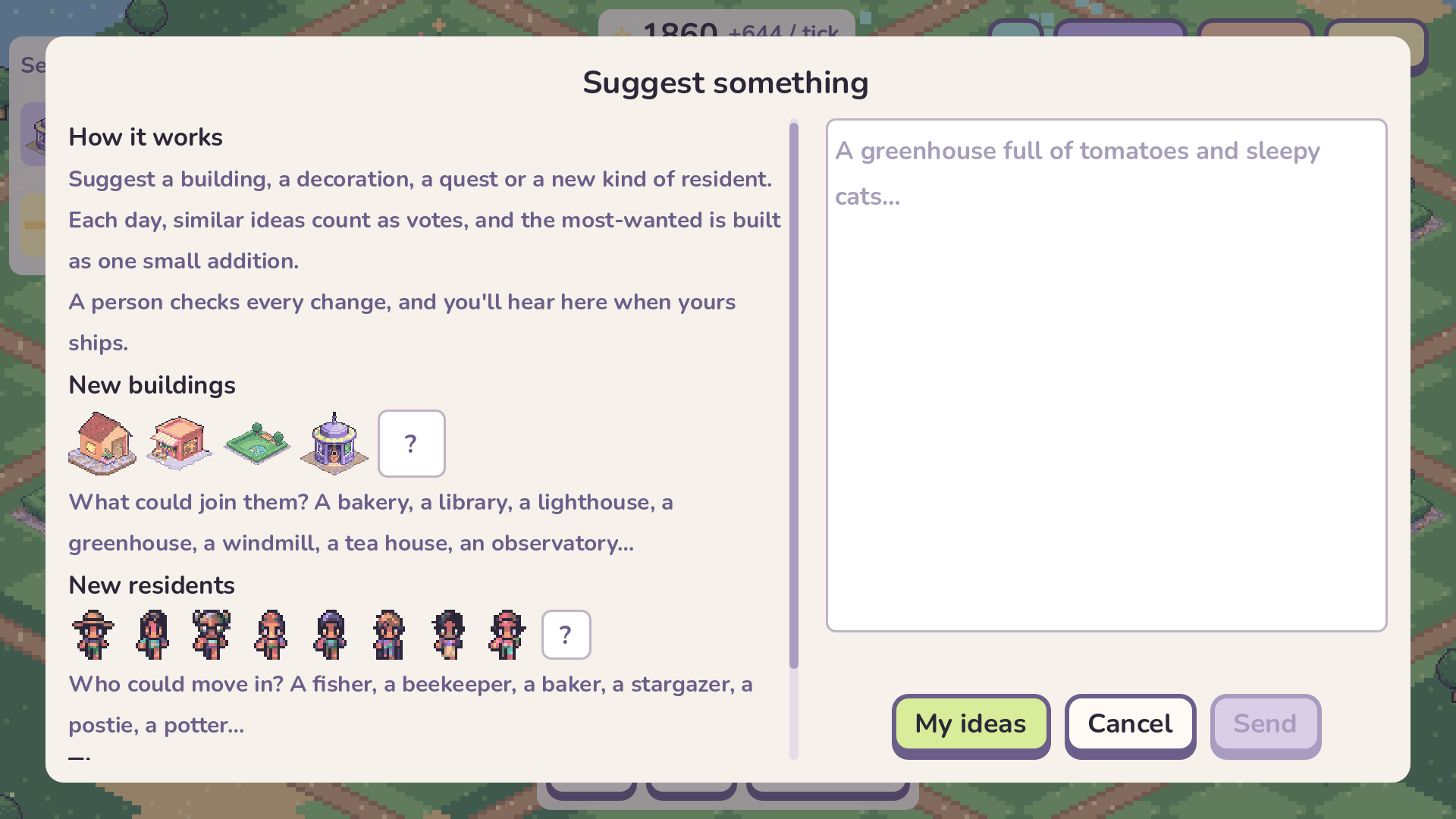
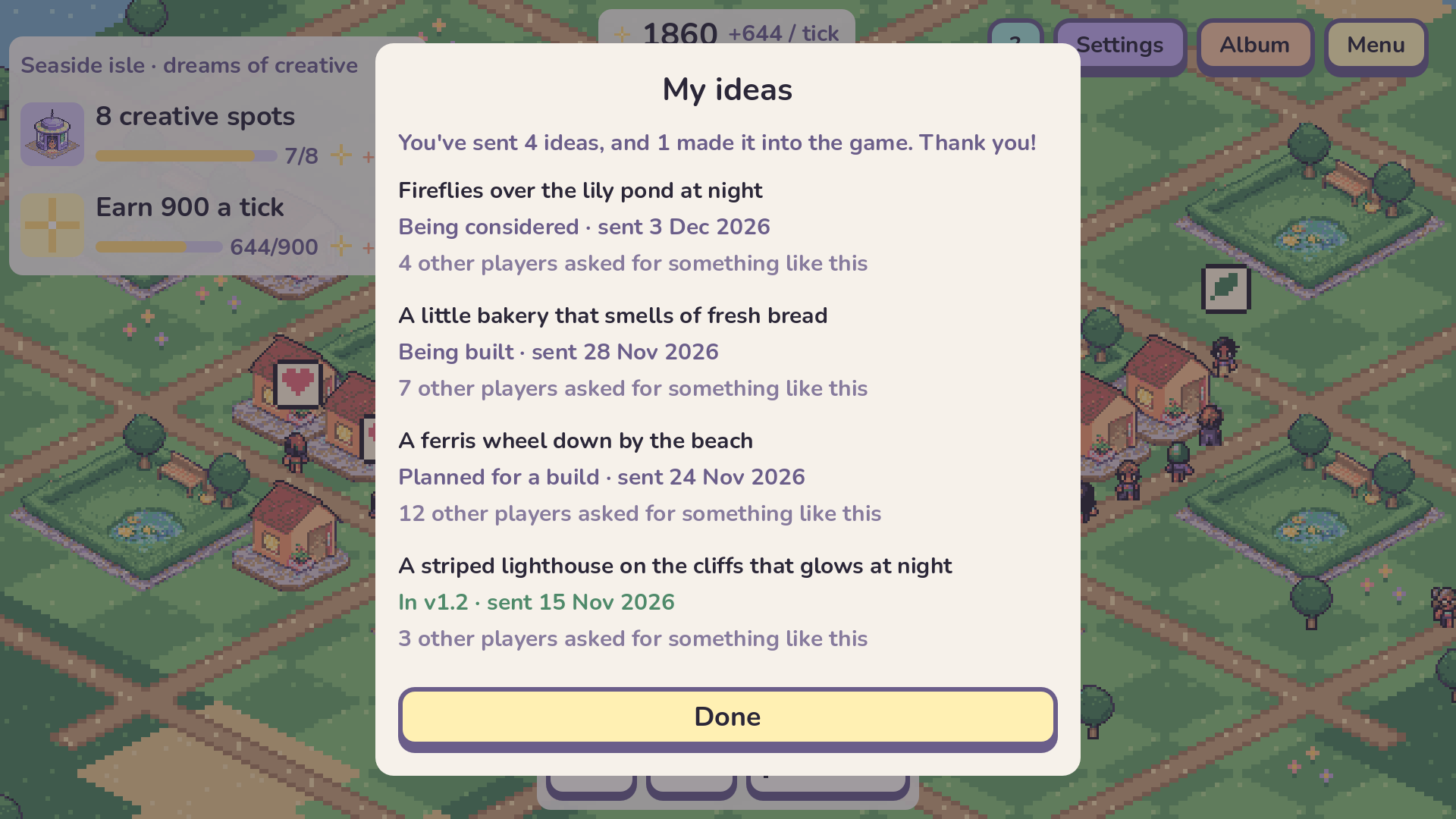
It's a cozy town builder: you grow a little island of cottages, cafés, parks and music spots, and arrange their moods so the neighbours get along. New players are welcomed with what the game is about, and on the main menu there's an Ideas button. Suggest what the island should have next, and the most-wanted ideas are built into new versions of the game. When one of yours ships, the game tells you.
The short version: n8n + local AI + Godot + my agentic engineering experience = a game that players help build and shape. Within reason.
From idea to build
Every step is either a machine doing the busy work, or me making a call. Here's one idea's trip:
- You suggest something playerA building, a decoration, a quest or a new kind of resident. The form nudges towards new buildings and residents, which are the easiest ideas to build well. It goes to my own server with an anonymous player number, so you can follow it and hear when it ships.
- Triage, once a day local AIA model running on my own hardware reads the day's ideas. It groups similar ones, so they count as votes, sets aside the ones that can't be built, and plans at most one small task: what to add, and how to tell it's done.
- I approve the task meThe task arrives in Slack with the ideas behind it. I approve it or turn it down.
- Art, picked by a person AI + meA new building or resident needs a sprite. Retro Diffusion draws a few candidates in the game's own palette, and I pick one, or ask for another set.
- The builder writes the change agentA coding agent on my own machine (localagent-box) works from the task, never from your words. It adds the building, its sprite and its place in the build menu, runs the game's tests and commits the change.
- Checks CI + AIGitHub runs the tests, including a play-through that builds a whole town with everything in the game, saves it and loads it back. Strict checks make sure the change only adds content. A review agent compares it with the task.
- I merge it meNothing reaches the game without me reading it first.
- The release train automatedEach evening, if anything was merged, a release builds the game, signs it, adds a line to the in-game "What's new" and sends it to Google Play's testing track.
- "Your idea is in this build" you againOnce the release is out, the ideas it built are marked as shipped, and the game shows you which version yours is in.
The stack
- Godot 4
- n8n
- A self-hosted model
- localagent-box
- GitHub Actions
- Retro Diffusion
- Postgres
- Slack
n8n is the conductor: a set of workflows on my home server that run triage, ask me for approvals, hand tasks to the builder, open the pull requests, start releases and post a daily digest. The database is the source of truth: every idea, task and release lives there, and each step the workflows take is a single, tested database function, so a confused model can't leave things half-done.
The model that reads ideas runs on my own hardware, so no AI company receives your words. Retro Diffusion only ever sees a short description that triage writes in its own words.
"Within reason"
Letting players steer a codebase sounds like an invitation to chaos, so most of the work went into the guardrails. They come in two kinds: judgement, where a model or I decide, and rules, which are plain code that can't be talked out of anything.
Ideas are data, never instructions. Only triage reads what players write, and its answer has to fit a fixed shape. Ideas that try to give the AI orders are discarded. The builder only ever sees the task.
Ideas add content; they don't change the rules. A task can add a new building, decoration, quest or resident look, and nothing else. CI checks each new thing's price, earnings and reach against what the game already has, so a new café is worth about what the old café is. Any change to the code or to something that already exists fails, however good the reason sounds.
A content standard. Makersville is for players 13 and up, and it's cozy: no violence, gambling, real brands or anything unkind. Triage and the review agent both read the same written standard.
Ideas that change how the game works aren't thrown away. They're kept for me and posted in a weekly review in Slack, most-wanted first. Some of them I'll build by hand, and the players who asked are credited all the same.
A person at every gate. I approve each task, pick each sprite and merge each change. The task approval can come off later, but only once the database has seen twenty approvals in a row without an edit or a revert, and a single revert puts it straight back on.
The first run. The very first task asked for a medical clinic. The builder came back with a clinic and a whole new mechanic: a building that lifts every mood around it, plus "care bubbles" over residents standing nearby. The game's tests passed, but CI rejected the change, listing all fifteen things it had changed beyond adding content. That run is where the "content only" line came from. Today an idea like that becomes a plain clinic, built by the loop, plus a note in my weekly review about the mood-lifting part.
Your ideas, your data
Sending an idea is optional; the game is complete without it. Your idea goes to my server with an anonymous number, not your name, email or Google account. The words are never published or shown to other players, and ideas that aren't picked lose their words after two years. "Delete my ideas" in Settings removes them straight away. The privacy policy has the details.
What's next
Makersville is on its way to Google Play. Once it's out, the island starts growing from what players ask for, one small build at a time. I'm curious what you'll make of it.